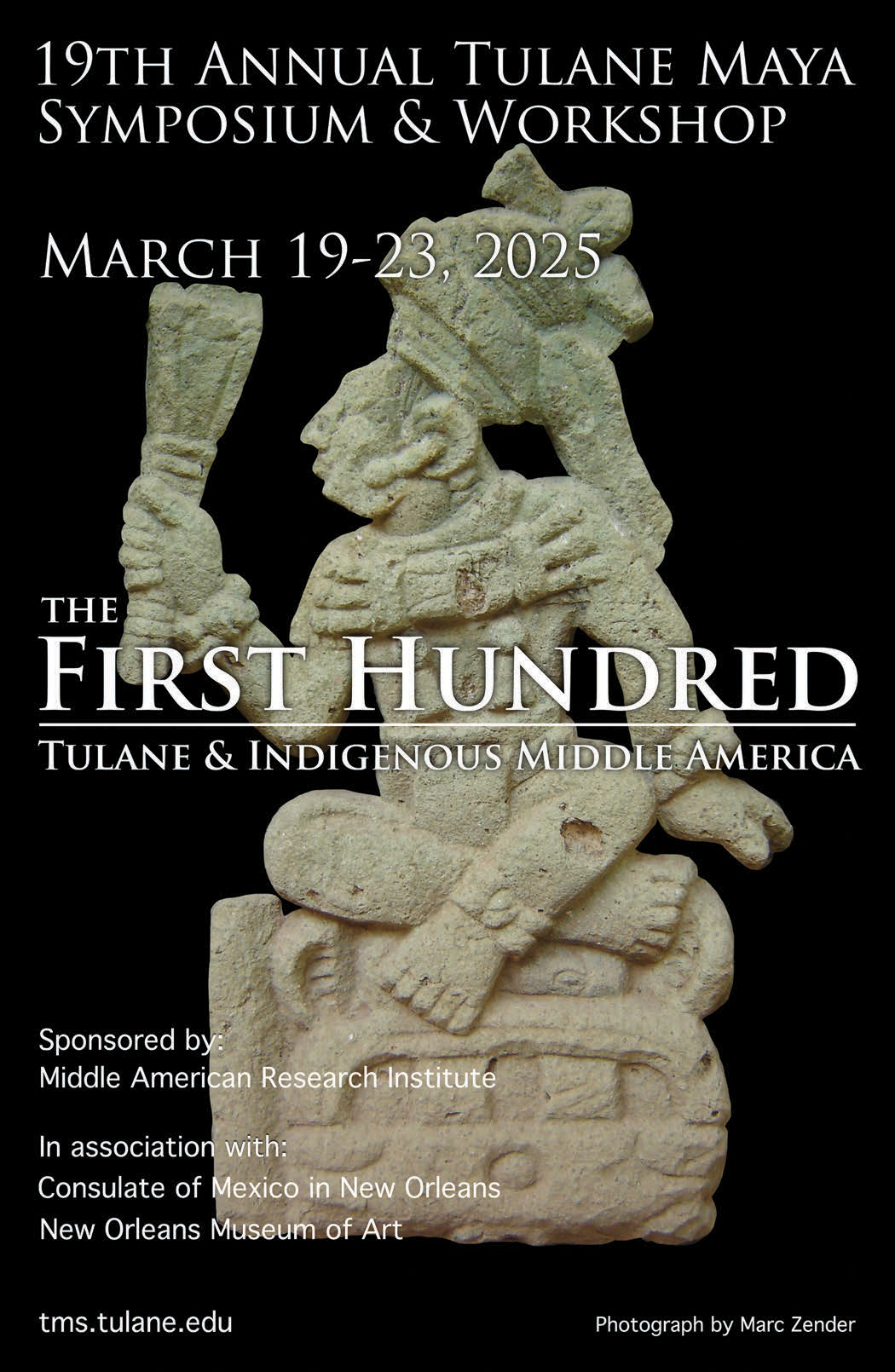
The goal of this symposium is to celebrate the first 100 years of the Middle American Research Institute at Tulane University, reflecting on a century of groundbreaking research on Indigenous cultures across Mexico and Central America. From pioneering excavations at ancient Maya cities to cutting-edge lidar surveys, robust collection digitization, and community-based collaborations, MARI has consistently advanced scholarship and preservation efforts.
Since 2002, Tulane University has hosted a weekend of talks and workshops dedicated to the study of the Maya civilization of Mexico and Central America. This yearly meeting has called upon scholars from a wide spectrum of specialties — archaeology, art history, cultural anthropology, epigraphy, history, and linguistics — to elucidate the many facets of this fascinating Mesoamerican culture. In developing a broad approach to the subject matter, we aim to draw the interest of a wide ranging audience — from the expert to the beginner.
To that end, we have assembled a wonderful group of scholars in Maya archaeology whose different fields of expertise will allow us to muster as diverse an array of evidence as possible. Given how rare of an accomplishment such a consortium is, please JOIN US!
Speakers
Wednesday Talk at the Mexican Cultural Institute
“The William E. Gates Collection and Its Significance for Maya Studies” — Pilar Regueiro Suárez, Middle American Research Institute
Friday Keynote Address at the New Orleans Museum of Art
“Precocious Pioneering, Steady Scholarship: MARI’s Century of Indigenous Research and Partnership” — Marcello Canuto, Middle American Research Institute, Tulane University
Saturday Symposium
“Tribes, Temples, and Tulane: Reflections on a Century of Olmec and Gulf Coast Archaeology” — Christopher Pool, University of Kentucky
“MARI’s Exploration and Mapping in the Maya Lowlands Yesterday and Today” — Francisco Estrada-Belli, Tulane University
“Snakes, Jaguars and Outlaws: An Epilogue” — Ricardo Agurcia Fasquelle, Asociación Copán
“The Middle American Research Institute and Highland Guatemalan Archaeology” — Eugenia Robinson, Montgomery College
“100 Years of MARI: A View from the South” — Kathryn Sampeck, Illinois State University & University of Reading
“Unearthing Yucatec Maya Histories: The Role of the Middle American Research Institute at Tulane University in Shaping My Journey into Colonial Ethnohistory” — John F. Chuchiak IV, Missouri State University
“The Northern Lights: MARI’s Presence in Yucatán, Mexico” — Tomás Gallareta Negrón, Instituto Nacional de Antropología e Historia
“From Ek Balam to Kiuic: Four Decades of MARI Inspired Archaeology in the Northern Maya Lowlands” — George Bey, Millsaps College
Workshops
“More Than Storage: Management of Archaeological, Ethnographic, and Archival Collections” — Caroline Parris, The University of Iowa
“Conservation Plan for Museum Storerooms” — Alison Salazar, Museo Larco
“Ethnoarchaeology: the Good, the Bad, the Old, and the New” — Maxime Lamoureux-St-Hilaire, Mount Royal University
“Who Shall Read Them? The Decipherment of Maya Hieroglyphs” — Markus Eberl, Vanderbilt University; Mary Kate Kelly, American Council of Learned Societies/University of Calgary; Marc Zender, Tulane University
“From the Bayou to the Bajo: Approaches in Louisiana Archaeology and Their Applicability to Mesoamerican Research” — Erlend Johnson, University of Louisiana at Lafayette
“From Data to Map: Visualizing Ancient Landscapes for Research” — Jocelyne M. Ponce, Tulane University
“When Stones Talk: Connecting Lithic Analysis and Raw Material Selection to Maya Daily Life” — Rachel A. Horowitz, Washington State University
Forum
“The Fallen Stucco Inscriptions of Comalcalco and Palenque” — Marc Zender, Tulane University; Marcello Canuto, Tulane University; Markus Eberl, Vanderbilt University; Mary Kate Kelly, American Council of Learned Societies/University of Calgary