
Twenty years after the creation of the School of Liberal Arts, the values that defined H. Sophie Newcomb Memorial College continue to shape the way Tulane educates, creates and leads.
Like the people within them, institutions evolve. Their names change, their structures are reorganized, and their missions expand in response to new generations and new ideas.
What matters is the purpose they are entrusted to carry forward.
When Tulane reorganized in 2006, H. Sophie Newcomb Memorial College entered a new chapter in its history. Its undergraduate education joined with Paul Tulane College to form Newcomb-Tulane College, while its academic departments became part of the newly created School of Liberal Arts. At the same time, the Newcomb Institute was established to advance gender equity through research, training, and community engagement.
For 120 years, Newcomb had been far more than the place generations of women earned a degree. Founded in 1886 as the nation's first coordinate college for women, it cultivated intellectual ambition, artistic expression, leadership and public purpose at a time when those opportunities remained rare for women.
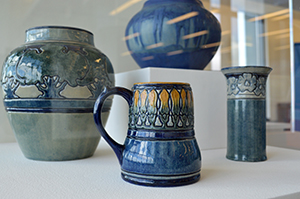
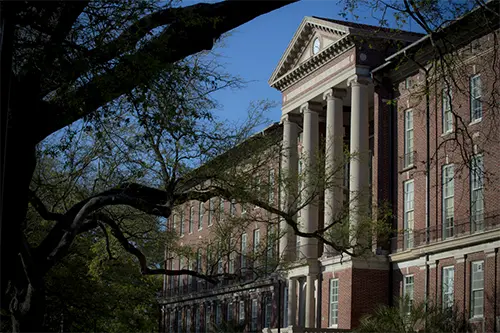
Walk across Tulane's campus today and traces of Newcomb appear in unexpected places. At the Newcomb Art Museum, exhibitions celebrate one of the nation's most influential Arts and Crafts traditions. Newcomb Pottery and decorative arts appear in academic buildings across campus, including Newcomb Hall. The Newcomb Institute continues to invest in leadership, scholarship and public engagement for a new generation. Together, they tell a story that stretches well beyond a single college.
A hallmark of Tulane grounded in Newcomb College’s excellence is in the visual arts. Under Ellsworth Woodward, Mary Given Sheerer and other pioneering faculty, Newcomb became home to one of the country's most distinctive Arts and Crafts enterprises. Students learned by making. Pottery, embroidery, metalwork, bookbinding, jewelry and textiles became part of an education that united creative practice with intellectual inquiry. Newcomb Pottery earned international recognition, but the lasting achievement was an educational model that encouraged women to build professional lives through art, design and craftsmanship. No two pieces were exactly alike. Neither were the women who created them.
That same philosophy extended well beyond the studio. Education was expected to prepare students for lives of consequence. Scholarship was connected to service, artistic practice to professional opportunity, and learning to the responsibilities of citizenship. Graduates became artists, educators, scientists, writers, civic leaders and advocates, carrying those values into communities far beyond Tulane.
As the twentieth century unfolded, students from Newcomb College and the College of Arts & Sciences increasingly shared faculty, classrooms and ideas. Long before organizational charts reflected it, a broader coeducational liberal arts community had begun to emerge.

That educational philosophy continues to find new expression across Tulane. The Newcomb Institute carries forward Newcomb College's historic commitment in a modern context.
“Institutions endure not because they remain unchanged, but because each generation renews their purpose,” said Anita Raj, Executive Director, Newcomb Institute. “Newcomb’s history reminds us that advancing equity requires both honoring the values that shaped us and responding to the challenges of our own time. That work continues today through our research, our students, our faculty, and the communities we serve.”
Within the School of Liberal Arts, Newcomb's influence is visible in an educational model that encourages students to connect scholarship with creative practice, move comfortably across disciplines and apply what they learn beyond the classroom. Those ideas continue to shape the School's understanding of a liberal arts education.

“The School of Liberal Arts benefits from a tradition that has shaped Tulane for generations,” says Brian T. Edwards, dean of the School of Liberal Arts. “Our responsibility is to honor that tradition by preparing students with the same spirit of intellectual curiosity, creativity and public engagement that has long distinguished a liberal arts education here.”
That responsibility is reflected in classrooms where New Orleans becomes part of the curriculum, where scholarship reaches public audiences and where creative practice sits comfortably alongside research. The disciplines have evolved. The expectation that education should prepare graduates to contribute meaningfully to the world remains.
Universities are remembered as much for the ideas they preserve as the institutions they create. Nearly 140 years after H. Sophie Newcomb Memorial College was founded, its influence can still be found across Tulane: in museum collections, in leadership programs, in interdisciplinary classrooms and in generations of graduates who continue to connect knowledge with purpose. That may be Newcomb College's greatest legacy: ideas that continue to find new expressions, new voices and new generations willing to carry them forward.
Newcomb's Legacy Today
Today, Newcomb College's legacy is carried forward across Tulane through institutions that preserve different aspects of its history and mission.
The Newcomb Institute advances gender equity through research, training, and community engagement that translates evidence into meaningful change.
The Newcomb Art Museum stewards one of the nation's premier collections of Newcomb Pottery and decorative arts while presenting exhibitions that connect historic collections with contemporary artists and ideas.
The School of Liberal Arts (SLA) continues part of Newcomb's educational philosophy through interdisciplinary teaching, creative inquiry and public engagement. Programs such as Gender & Sexuality Studies, along with faculty across the humanities and social sciences, encourage students to explore questions of culture, identity, leadership and society from multiple perspectives. Newcomb Art Department and Newcomb Department of Music continue the legacy of the school that created them, now in SLA.
Under the Oaks remains one of Tulane's enduring Newcomb traditions, bringing generations of Newcomb alumnae together each year to celebrate a shared history while welcoming new Newcomb Institute graduates into the community.