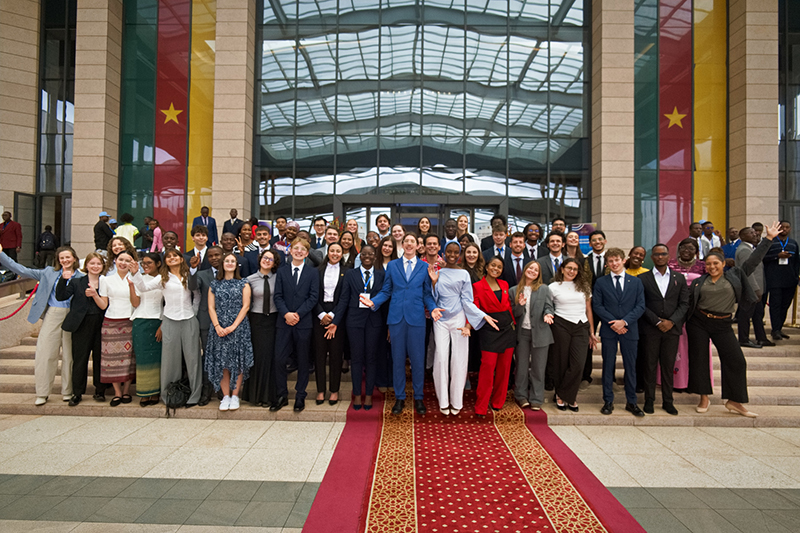
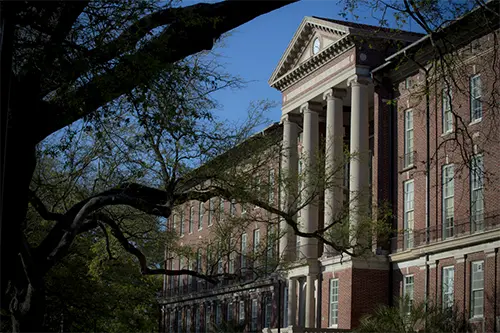
This summer, I had the opportunity to represent Louisiana on an international stage at the 11th Parlement Francophone des Jeunes (PFJ) in Yaoundé, Cameroon. Sponsored by the Council for the Development of French in Louisiana (CODOFIL), my journey to Cameroon brought together many of the things that have shaped my education at Tulane: my connection to Louisiana, my love of the French language, my studies in the liberal arts, and my belief in the power of cultural exchange.
For five days, I joined young leaders from across the Francophone world to debate, collaborate, and develop solutions to issues affecting young people today. I was the only participant from the United States. By the end of the week, I had made friends from Gabon, Côte d’Ivoire, Rwanda, Switzerland, Jersey, Cyprus, Albania, Cambodia, Laos, Mauritius, and beyond. What struck me most was how quickly a shared language could turn a room full of strangers from different countries and backgrounds into a community.
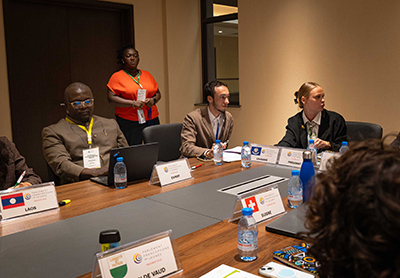
Each day, we traveled to the National Assembly in Yaoundé, where the PFJ was modeled after the structure of the Parliamentary Assembly of La Francophonie (APF). We began the week by learning about the work ahead before being divided into four commissions. Each commission focused on a different topic, with the subjects rotating from year to year. I was assigned to the Commission on Education, Culture and Communication, which focused on “Social Media and Young People: How to Manage Its Proper Use.”
My education at Tulane helped prepare me for this experience in ways I recognized throughout the week. Studying political science and sociology has taught me to approach complex issues from multiple perspectives, while my liberal arts education has encouraged me to remain curious, ask questions, and listen to experiences different from my own. Those skills became especially important when I was working with young people whose experiences, cultures, and political systems differed from mine.
My political science courses have given me a foundation for understanding the international issues we discussed at the PFJ. Courses such as Introduction to International Relations and International Development have encouraged me to think beyond national borders and understand how political and social issues intersect across countries. At the same time, Cajun & Creole Politics has helped me understand the political and cultural history of my own community. Together, these courses have reinforced something I experienced firsthand in Cameroon: understanding the world requires understanding where you come from, too.
My French coursework has been equally important. Classes such as French for World Affairs and Sustainable Development in the Francophone World have allowed me to explore Francophone communities, with an emphasis on those in Africa, and issues beyond the European context that often dominates discussions of the French-speaking world. Learning from professors with connections to different regions of the Francophone world has made those communities feel less distant and has challenged me to think more broadly about what it means to speak French. That perspective came to life in Cameroon. I was able to use French not simply as a language I had studied in a classroom, but as a tool for building relationships, exchanging ideas, and participating in difficult conversations. Every conversation gave me another opportunity to practice, make mistakes, learn, and try again.
I was honored to serve as president of my commission, which meant leading discussions and helping guide our group toward a consensus. Over the course of two days, we spent more than 15 hours debating our topic, listening to perspectives shaped by different countries and cultures, and working together to draft a resolution.
That process was one of the most meaningful parts of the experience. We did not always agree, but we learned how to listen, ask questions, and find common ground. At the end of the conference, each commission presented its resolution to the other young parliamentarians, who could debate and amend the proposals before voting on them. We then presented our work to members of the APF, including professional parliamentarians and political leaders who participate in the organization’s work.
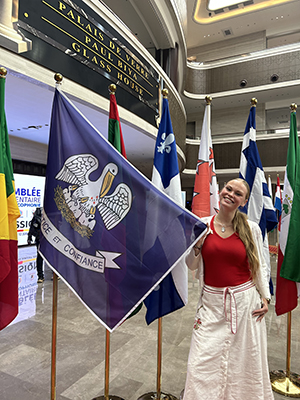
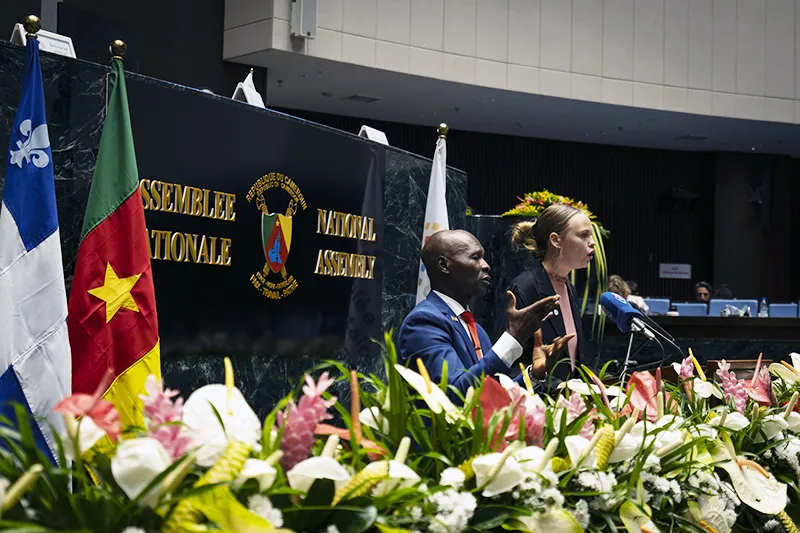
I also had the opportunity to speak before the assembly about another issue that felt particularly personal: climate change. During the final day of the conference, I took the podium to address the other participants and leaders, including past APF President Hilarion Etong. I spoke about the realities of climate change in Louisiana, a place where environmental issues are not abstract.
“In Louisiana, this reality is particularly visible. We are facing more intense hurricanes, coastal erosion, and rising sea levels. The consequences of climate change are not theoretical: they are already affecting our communities.”
Standing in front of an international audience and speaking about my home state made me realize how much Louisiana has shaped the way I understand global issues. I was not only representing Louisiana in Cameroon; I was also representing Tulane and the School of Liberal Arts.
The experience reminded me that language education is about much more than becoming fluent. Speaking another language opens doors to people and perspectives that might otherwise remain inaccessible. For me, the PFJ was a chance to see that firsthand, to bring my Louisiana perspective into a global Francophone community and to bring what I learned there back home.
I left Cameroon with new friendships, a deeper understanding of the Francophone world, and an even stronger appreciation for the role that language can play in connecting communities. Most importantly, the experience showed me the value of a liberal arts education that encourages students to look outward while remaining grounded in their own communities. From Louisiana to Cameroon, I saw how the language I have spent years learning can create opportunities to listen, lead, and build connections across borders.