I read a line recently written by a filmmaker I know and admire, Sian-Pierre Regis, that has stayed with me. It was part of a reflection on his mother and a recent journey they shared: “This great adventure helped me to know, from the deepest part of me, that I am distinctly *her* son. And is there any greater knowing than knowing where you came from?”
Sian-Pierre’s words so succinctly synthesized a feeling that took root for me when I began planning an Office of Study Abroad program I led this summer in partnership with the School of Liberal Arts’ Strategy, Leadership and Analytics Minor (SLAM). The centerpiece SLAM course, “Beyond Paradise: Leadership and Sustainability in The Bahamas,” draws from an experiential learning framework inspired by my experience at The Island School’s Educators Conference last summer in Eleuthera, Bahamas.
In the program’s origin story, I often blame my notoriously poor dream recall for the seed of this idea. I awoke one morning in March 2025, and my first thought was that I needed to develop a study abroad program in The Bahamas that centered leadership. Why The Bahamas? And why leadership?
My father and his ancestors trace their lineage to one of the Family Islands in The Bahamas dating back to the 17th and 18th centuries. The island of Spanish Wells is half a mile wide and two miles long and is densely populated with ~1,600 people who have lived there for centuries. My parents and siblings lived in The Bahamas in the 1970s and moved back to the U.S. shortly before I was born. Every summer since age 11, I was a perpetual unaccompanied minor on flights back to The Bahamas to spend the season with family friends and relatives in Nassau, Abaco and on Spanish Wells. The freedom and independence of those summers have always stayed with me —— unstructured time to draw, read, play, connect, learn, wander and (very importantly!) eat conch fritters, coconut ice cream and rock lobster.
When my father passed away of COVID in 2022, I started returning to Spanish Wells quite often. In the wake of a complicated and mostly estranged relationship, I understood that the most meaningful inheritance my father left me was this connection to a place and a country I loved. A second dawning came soon after: that my earliest experiences in The Bahamas as a child shaped my identity and my leadership in ways that I had struggled to name until four decades later.
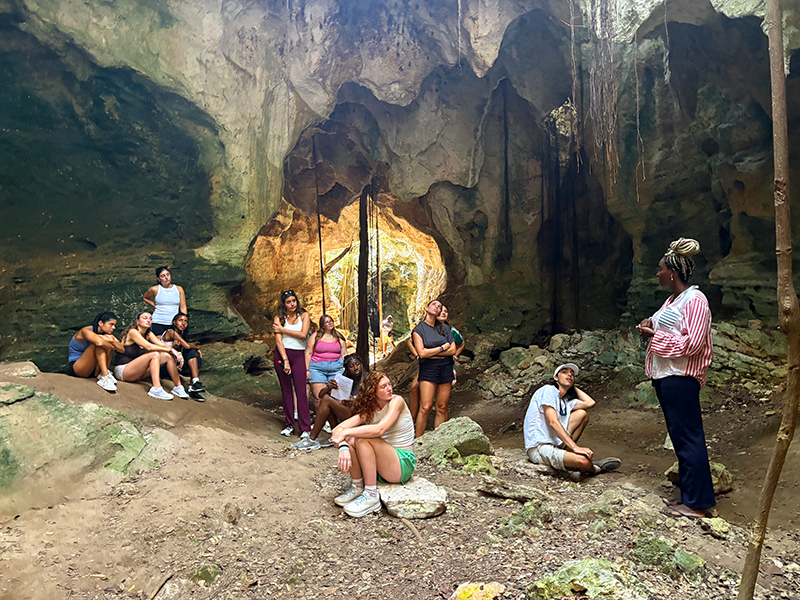
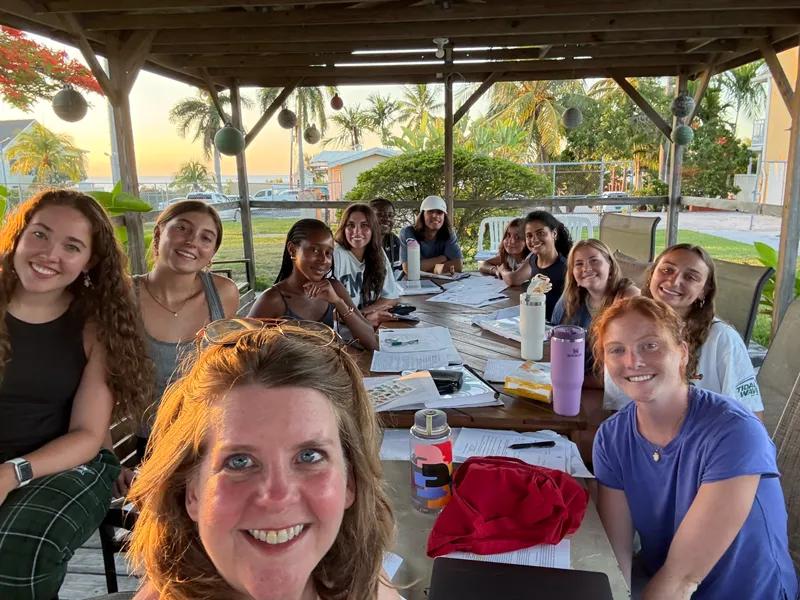
In the clearing of that dream last year, I built a study abroad program for students that allowed them to cultivate a deeper connection to place, while both learning about their own inherent leadership potential and learning from the rich experiences of visionaries in The Bahamas who center sustainability in their leadership practice. Fifteen months later, I was standing on the tarmac of the Rock Sound airport on the island of Eleuthera with 11 Tulane students ready to embark on our two-week journey.
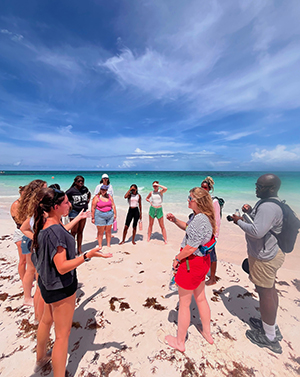
For this first cohort, I designed an analog course (no laptops, old school reading packet, virtually no devices for the first week) that would combine an academic study of leadership, sustainability and culture with community engagement and service learning in The Bahamas. Through the lens of critical tourism studies, we started by interrogating the concept of “paradise,” problematizing how this notion often omits the real-world challenges that island communities face, allowing visitors to experience natural beauty and unexamined luxury without probing the complexities of a tourism economy.
We then shifted to studying the on-the-ground leadership strategies of Bahamians across a variety of sectors — tourism, community development, environmental sustainability, science, education, agriculture, fisheries and entrepreneurship. Occurring in concert with our academic studies and conversations with local leaders, students were on their own personal leadership journeys, exploring their individual strengths and building their unique capacity for leadership as change agents for a more sustainable future. We learned from farmers on Eleuthera, fishermen in Spanish Wells, non-profit leaders at the One Eleuthera Foundation, scientists at the Cape Eleuthera Institute, an innovative school founder in Nassau and Tulane alum Kimberly Furnish, who serves as Deputy Chief of Mission at the U.S. Embassy in Nassau.
As a professor, you often deeply consider what future impact a course you build might have for your students. What will they hold on to? What might sharpen their critical thinking skills in a world that demands discernment more than ever? This experience poignantly showed me how I could be transformed by the exchange of learning happening at every turn in our experiential classroom. In sharing a place so generationally foundational to me and bearing witness to the lessons students found in the words of many leaders we met and scholars we read, I found my answer to Sean-Pierre’s question: “And is there any greater knowing than knowing where you came from?”