
Education
Biography
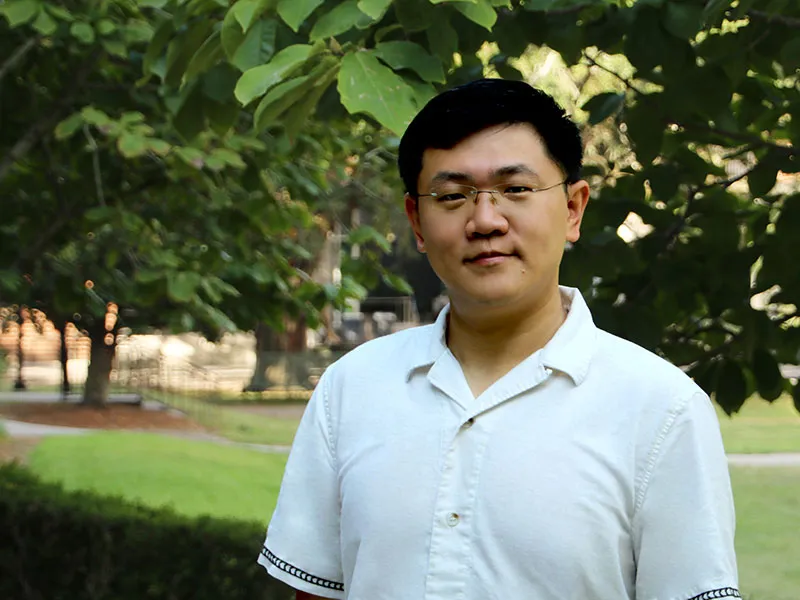
Xiaoyue Yasin Li is an Assistant Professor of History and MENA Studies. He received his Ph.D. in history from the University of Michigan, Ann Arbor in 2021. As a historian of the modern Middle East, Xiaoyue Li’s scholarship centers on techno-infrastructure within its broader social milieu in Egypt, and explores the interplay of materiality, technology, capitalism, and everyday politics. He is preparing the first manuscript for publication, tentatively titled Frictions into Forward: Empire, Capital, and Rail Infrastructure in Egypt. His writings appear in the American Historical Review, the International Journal of Middle East Studies, Technology and Culture, Modern Intellectual History, and the Durham Middle East Papers. His research has been supported by the ACLS Fellowship, and his dissertation won the Middle East Studies Association’s Malcolm H. Kerr Dissertation Award in Social Sciences. Before joining Tulane, Li held academic positions at the University of Michigan and Colby College.
Research Interests
Xiaoyue Li’s book project, Frictions into Forward: Empire, Capital, and Rail Infrastructure in Egypt, traces the mechanical, institutional, and most significantly, socioeconomic frictions precipitated by the technopolitical restructuring of the Egyptian railway between the 1830s and 1924. It argues that these frictions, which operated simultaneously at local, regional, and global scales, shaped the contours of infrastructural development rather than impeding it. They embedded the technology into the fabric of Egyptian society and propelled its accelerated transformation into a spatially expansive, heavily capitalized, and centrally administered infrastructure indispensable for popular, albeit compartmentalized, mobility.
Drawing on archival and published sources from Britain, Egypt, France, and the United States, the book juxtaposes vexing state policies with the railway’s quotidian uses and usurpations, set against the looming specter of a monumental debt crisis. Persistent frictions along the tracks reconceptualize the Egyptian railway as a contested frontier infrastructure of imperial, capital, and state expansion. Further, this focus illuminates the infrastructure’s entrenched entanglement with global histories of empire, capital, technology, and mass politics. By centering friction, the book highlights the multilayered politics in motion that oscillated between modernity and indigeneity, capitalization and decolonization, autocratic reality and democratic ethos.
In addition to this primary project, Li pursues broad scholarly interests in technology and society, global history, and language learning, where he joyfully gleans ideas for future research and teaching. Outside of work, Li enjoys racquet sports, historical video games, flying recreational drones, and poking AI with Socratic traps.
Publications
Articles
“From Postcolonial to Muslim Worlds: The Metamorphosis of Egalitarian Thought in Gamal al-Banna’s Works,” Modern Intellectual History 26, no. 1 (2026): 195-219.
“Rails of the Royal: Environment, Economy, and Engineering of the Mariut Railway,” Durham Middle East Paper, no. 112 (2025): 1-32.
“China-Egypt Relations: Constructing Images and Perceptions in the ‘Belt and Road Initiative.’” In Rethinking China, Middle East and Asia in a “Multiplex World.” Edited by Mojtaba Mahdavi and Tugrul Keskin. Leiden, Netherlands: Brill, 2022. 147-161.
“Usurpers of Technology: Train Robbery and Theft in Egypt, 1876-1904,” International Journal of Middle East Studies 53, no. 2 (2021): 195-212.
Reviews
Review of Harvests of Liberation: Cotton, Capitalism, and the End of Empire in Egypt by Ahmad Shokr, American Historical Review 141, no. 1 (2026): 350-52.
Review of The Sublime Post: How the Ottoman Imperial Post Became a Public Service by Choon Hwee Koh, Technology and Culture 66, no. 4 (2025): 1230-32.
Review of Electrical Palestine: Capital and Technology from Empire to Nation by Fredrick Meiton, Technology and Culture 63, no. 2 (2022): 563-65.
Awards
ACLS Fellowship, 2024-25.
Malcolm H. Kerr Dissertation Award in Social Sciences, Middle East Studies Association (MESA), co-winner, 2022.
Service
Intellectual Life Committee, History Incubator (2025-now)
Courses
- HISM 1500 China and the Islamic World: Commodity, Ecology, Infrastructure
- HISM 2200 Pre-Modern Islamic History
- HISM 2210 History of the Modern Middle East
- MENA 3810 Arab-Israeli Historical Perspectives
- HISM 6333 Technological Middle East
- HISM 6910 Bandit, Terrorist, and Freedom Fighter: A History of Insurgency in the Global South